
Ask most business leaders about artificial intelligence today, and the conversation quickly turns to ChatGPT, Claude, Gemini, Copilot, or another generative AI platform.
It’s understandable. Generative AI has captured headlines, transformed how people interact with technology, and made AI more accessible than ever before. But its popularity has also created an unintended misconception that generative AI is the only opportunity for enterprises to benefit from AI.
That way of thinking can limit what’s possible.
When business leaders ask, “How can we use ChatGPT or Copilot?” instead of “What business problem are we trying to solve?”, they overlook technologies that have been creating measurable business value for decades.
Artificial intelligence is not new, and it is certainly not limited to generative capabilities. It is an umbrella term encompassing a wide range of technologies and disciplines, each designed to address different business challenges.
The key to successful enterprise AI isn’t adopting a particular technology. It’s understanding which AI capabilities can create value for the business – and integrating them into the way the organization operates, competes, and grows.
Understanding this broader landscape is the first step toward building an AI strategy that delivers meaningful and lasting business value.
A Brief History of AI
Although AI has become one of today’s most talked-about technologies, the concept is far from new.
Artificial intelligence has been an area of computer science research since the 1950s. Over the decades, advances in computing power, data availability, and machine learning algorithms transformed AI from an academic pursuit into practical business applications.
Long before generative AI entered the mainstream, organizations were already using AI to detect fraudulent transactions, forecast demand, recommend products, optimize supply chains, interpret medical images, and improve countless operational processes.
ChatGPT didn’t introduce artificial intelligence.
It introduced millions of people to one branch of AI through a conversational interface.
That’s an important distinction because understanding AI as a broader ecosystem helps organizations identify opportunities beyond the latest generative AI trend.
AI Is an Ecosystem, Not a Single Technology
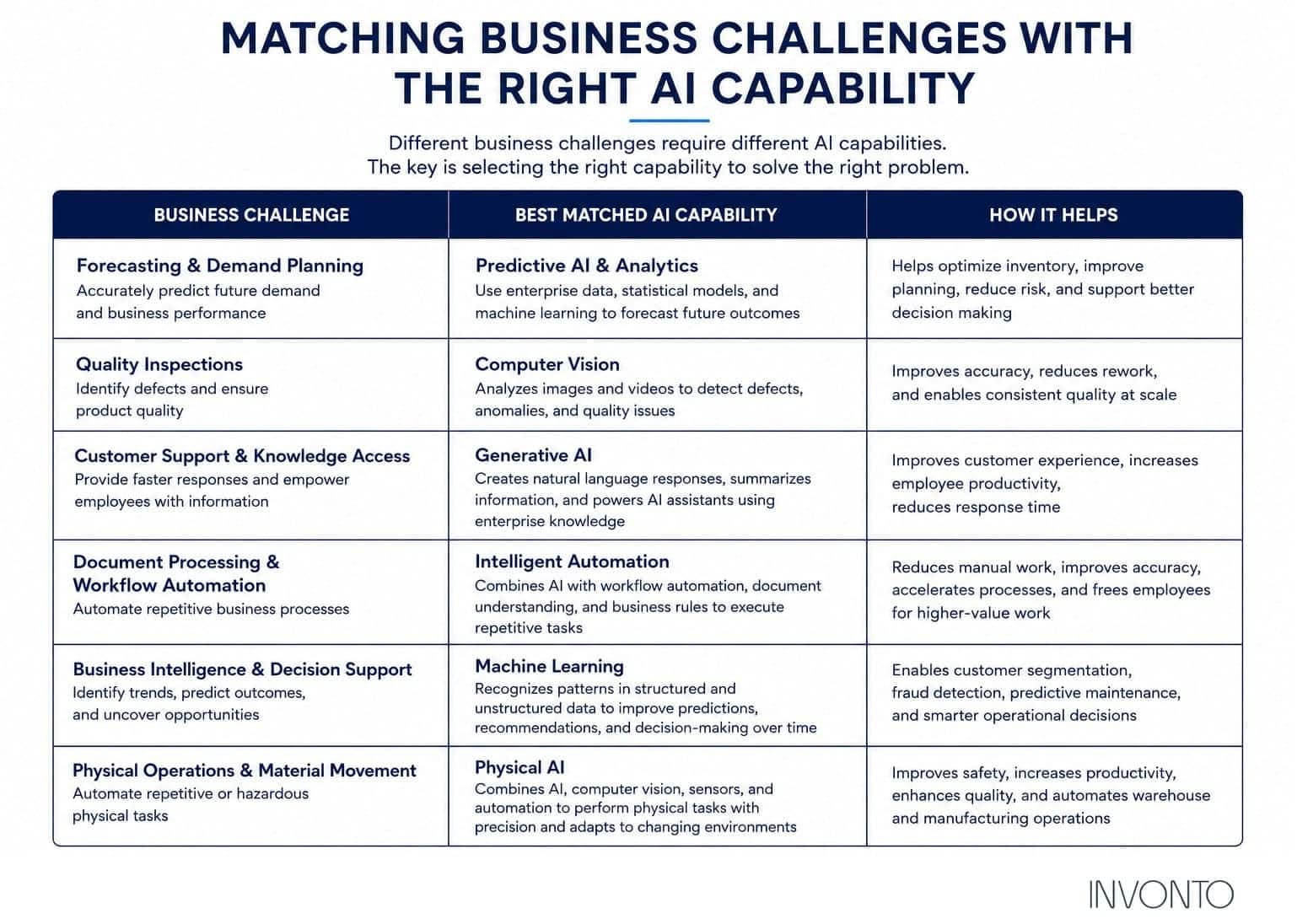
Every organization faces different business challenges, so there is rarely a one-size-fits-all AI solution.
Some organizations want to improve forecasting. Others are focused on enhancing customer experiences, identifying quality issues, automating repetitive tasks, or helping employees make faster decisions.
The right AI capability depends on the problem you’re trying to solve.
While artificial intelligence includes many specialized disciplines, the following categories represent some of the key AI capabilities enterprises can use to improve performance, transform operations, and create new business value.
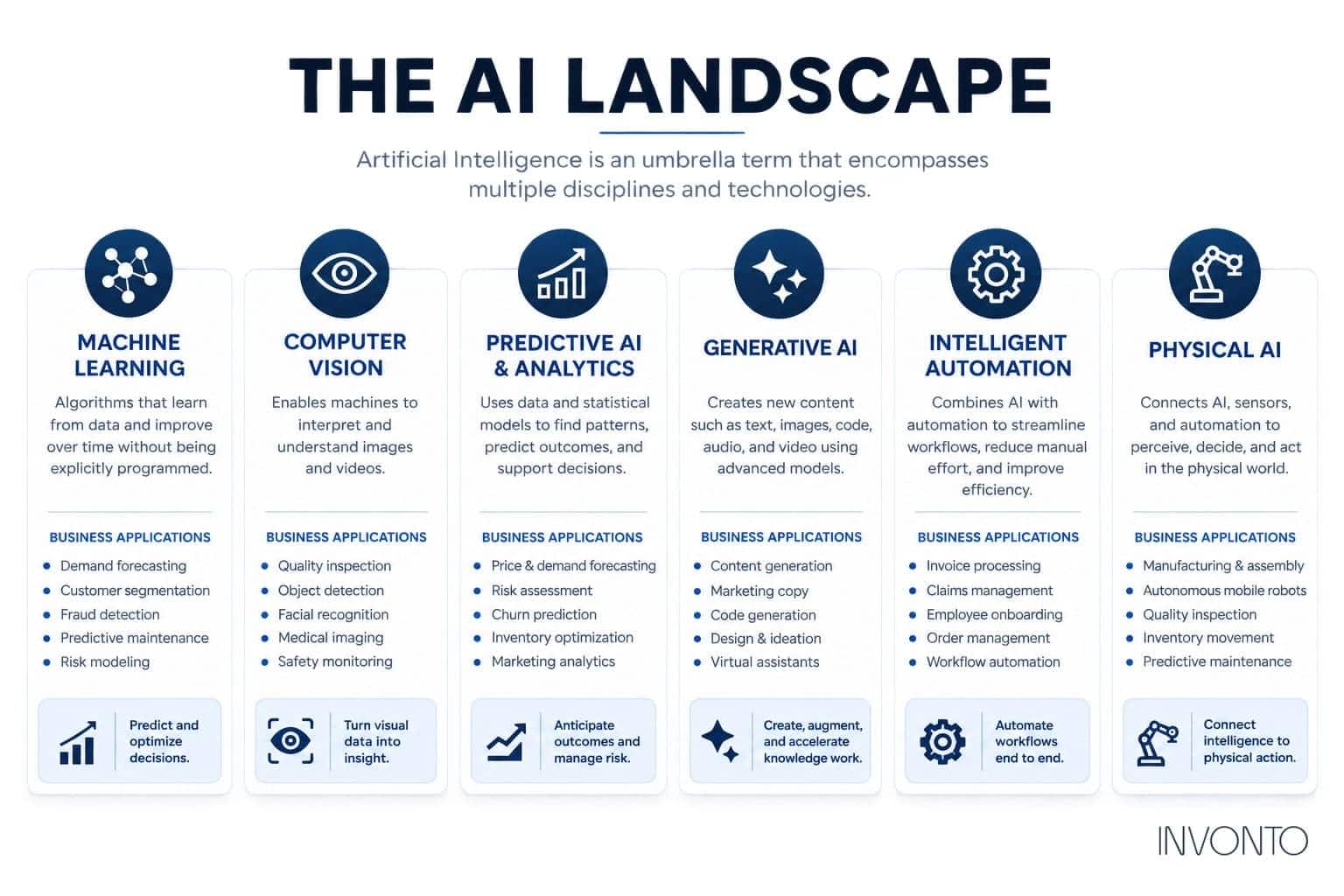
Machine Learning
Machine learning enables systems to recognize patterns in data, identify trends, and make predictions based on historical and real-time information.
For organizations, this can mean making smarter decisions based on data rather than relying solely on intuition or static rules. Machine learning models can also be retrained with new data, allowing them to adapt as business conditions change.
A retailer, for example, can analyze purchasing behavior to forecast seasonal demand, helping reduce excess inventory while ensuring products remain available. Manufacturers can use machine learning to predict equipment failures before they occur, minimizing downtime and reducing maintenance costs.
Common applications include:
- Predictive maintenance
- Customer personalization
- Inventory optimization
- Sales forecasting
- Demand planning
- Fraud detection
Computer Vision
Computer vision enables machines to interpret and analyze visual information from images and video.
Organizations use computer vision to automate visual inspection, improve quality control, monitor operations, and identify patterns that may be difficult or time-consuming for people to detect consistently.
Manufacturers, for example, can use computer vision to inspect thousands of products every hour and automatically identify defects before products reach customers. Healthcare organizations can use it to assist with medical imaging, while retailers can apply it to understand customer behavior and improve in-store experiences.
Common applications include:
- Manufacturing quality inspection
- Medical imaging
- Warehouse automation
- Retail analytics
- Workplace safety monitoring
- Object detection and recognition
Predictive AI & Analytics
Organizations generate enormous amounts of data every day, but data alone doesn’t create value. AI can help transform that information into actionable insights.
Predictive analytics combines AI, machine learning, and statistical modeling to identify patterns, forecast future outcomes, and support better decision-making. Rather than simply reacting to events after they happen, organizations can anticipate demand, identify risks, and optimize operations before problems occur.
Healthcare organizations, for example, may identify patients at higher risk of readmission. Financial institutions can use predictive models to assess risk and forecast trends, while manufacturers can optimize production schedules based on anticipated demand.
Common applications include:
- Financial forecasting
- Customer retention analysis
- Demand forecasting
- Supply chain optimization
- Risk management
- Workforce planning
- Business intelligence
Generative AI
Generative AI has become the most recognizable branch of artificial intelligence because it has made AI accessible through natural-language interactions and the ability to generate new content, including text, images, code, audio, and video.
Powered largely by advances in natural language processing (NLP) and large language models, generative AI enables organizations to interact with technology using natural language while accelerating knowledge work across the enterprise.
Its greatest enterprise value often comes when it is connected to organizational knowledge and business systems, allowing employees to access relevant information, automate content creation, assist customers, and accelerate everyday work.
Common applications include:
- AI assistants and copilots
- Customer support
- Content creation
- Document summarization
- Software development
- Knowledge management
- Translation and language assistance
Intelligent Automation
Intelligent automation combines technologies such as natural language processing, large language models, machine learning, and workflow automation to streamline repetitive business processes.
Rather than simply automating individual tasks, intelligent automation can understand information, make decisions within defined parameters, move data between systems, and route exceptions to people when human judgment is required.
Insurance providers, for example, can automate claims processing by extracting information from documents, validating data, and routing exceptions to specialists. Financial institutions can automate compliance reviews, while HR departments can streamline employee onboarding.
Common applications include:
- Invoice processing
- Claims management
- Employee onboarding
- Order processing
- Document processing
- Workflow automation
- Compliance automation
Physical AI
Physical AI integrates artificial intelligence into machines and physical systems. It combines AI models and algorithms with sensors, computer vision, and hardware to perceive environments, reason about physical situations, and take real-world actions.
While industrial robots have existed for decades, advances in AI are enabling a new generation of intelligent physical systems that can adapt to changing environments, collaborate more effectively with people, and make decisions using real-time data.
Although Physical AI is still closely associated with industrial and manufacturing applications, organizations across logistics, warehousing, healthcare, agriculture, consumer products, and field operations are increasingly exploring AI-powered physical systems to improve efficiency, enhance safety, and automate repetitive or hazardous tasks.
Common applications include:
- Manufacturing and assembly
- Warehouse automation
- Autonomous mobile robots (AMRs)
- Inventory movement
- Precision inspection
- Surgical assistance
- Hazardous environment operations
Why Many Enterprise AI Initiatives Fall Short
Understanding the AI landscape is only the first step. The bigger challenge for enterprises is turning these technologies into measurable business value.
Artificial intelligence has evolved from experimentation to enterprise adoption at an unprecedented pace. As organizations explore generative AI, intelligent automation, predictive analytics, Physical AI, and other capabilities, AI investment continues to grow across industries.
Yet many organizations struggle to realize the business value they expected.
AI pilots often fail to reach production. Promising use cases stall after initial deployment. Employees may have access to AI tools without incorporating them into their daily workflows. And organizations can end up with isolated technologies that deliver limited business impact.
The challenge isn’t necessarily that AI doesn’t work or cannot deliver ROI.
More often, the problem is how organizations approach AI.
They may prioritize technology over business objectives, underestimate the importance of data and integration, or measure success by implementation and adoption rather than business outcomes.
Understanding these challenges can help organizations avoid costly missteps and build AI initiatives that deliver measurable, long-term value.
Treating AI as a Technology Initiative Instead of a Business Initiative
One of the biggest misconceptions surrounding AI is that implementing AI will automatically create business value.
Too often, organizations begin by following technology trends without first evaluating the business problem they want to solve. As a result, they deploy technology without a clear strategy for how it will improve operations, support employees, enhance customer experiences, or contribute to growth.
Successful AI initiatives start with business objectives and then determine which AI capabilities can best support those objectives.
Implementing AI Without a Strong Data Foundation
Like any technology solution, the outcome of an AI solution depends heavily on the quality of the data supporting it.
When enterprise data is inaccurate, incomplete, inconsistent, or inaccessible, AI solutions can produce unreliable results.
Many organizations underestimate the importance of data quality, governance, and accessibility. Even sophisticated AI models cannot consistently deliver reliable insights when the underlying information is poor.
A strong data foundation is therefore not simply an IT consideration. It is an important prerequisite for scaling AI across the enterprise.
Deploying Standalone AI Instead of Connected AI
Many AI projects begin as isolated pilots that never become part of everyday business operations.
An AI assistant that cannot access relevant customer information, operational data, or internal knowledge has limited value. Likewise, predictive models disconnected from enterprise systems may fail to influence real business decisions.
Organizations can create significantly more value when AI is integrated with systems such as CRM, ERP, customer portals, business intelligence platforms, and operational workflows.
The goal is to make AI part of how work gets done, not simply add another application to the technology environment.
Measuring AI Success by Adoption Instead of Business Impact
Many organizations celebrate launching an AI tool across the enterprise without evaluating the outcomes it produces.
The success of an AI solution shouldn’t be measured primarily by how many employees use an AI assistant, how frequently they use it, or how many AI platforms have been deployed.
Instead, organizations should focus on measurable business results such as improved productivity, reduced operating costs, faster decision-making, higher customer satisfaction, increased revenue, or reduced risk.
When AI initiatives are tied to meaningful business metrics, leaders can make better investment decisions and demonstrate the value of AI across the organization.
How Enterprises Can Maximize Return on Their AI Investments
Artificial intelligence has the potential to transform how organizations operate and compete, but adopting AI does not automatically create a return on investment.
The organizations realizing the greatest value from AI take a strategic approach. They align AI initiatives with business priorities, establish the right foundation, integrate AI into existing operations, measure outcomes, and scale what works.
They also look beyond efficiency and ask how AI can help create new products, services, experiences, and sources of growth.
While every organization’s AI journey will be different, six principles can help enterprises maximize the value of their AI investments.
1. Start With Business Priorities, Not AI Technology
One of the biggest mistakes organizations make is beginning their AI journey by following technology trends instead of identifying the business problem they want to solve.
Instead of asking:
“How can we use ChatGPT?”
Ask:
“What business challenges are we trying to solve?”
That shift changes the conversation from experimenting with technology to creating measurable business value.
Some challenges may be best addressed with generative AI. Others may benefit more from machine learning, computer vision, predictive analytics, intelligent automation, or Physical AI. In many cases, the greatest value comes from combining multiple AI capabilities with existing enterprise technologies.
Successful AI strategy begins with business objectives and then identifies the AI capabilities that can best support those goals.
The objective isn’t to implement AI everywhere. It is to identify where AI can create the greatest strategic and operational impact.
2. Build a Strong Data and Technology Foundation
AI is only as effective as the data, systems, infrastructure, and governance supporting it.
Before implementing AI at scale, organizations should evaluate the quality, accessibility, security, and governance of their data. They should also understand how AI solutions will interact with existing enterprise applications and technology infrastructure.
A strong foundation enables organizations to build AI solutions that are more reliable, scalable, and easier to integrate into existing operations. It also reduces the risk of creating isolated experiments that become difficult to maintain or expand.
Organizations don’t necessarily need to rebuild their entire technology environment before adopting AI. Instead, they should strengthen the parts of their data and technology foundation that are most critical to the AI opportunities they want to pursue.
3. Integrate AI Into Existing Business Workflows
AI delivers the greatest value when it is embedded into the workflows employees use every day – not when it operates as a standalone tool.
Connecting AI with enterprise systems such as ERP, CRM, customer portals, supply chain platforms, and business intelligence tools enables organizations to automate processes, improve decisions, and provide employees with relevant insights at the point of need.
For example, an AI assistant connected to enterprise knowledge can help employees find information without searching across multiple systems. A predictive model connected to supply chain systems can help teams respond to changing demand. Intelligent automation can move information between systems and route exceptions to the right people.
The goal isn’t simply to give employees access to AI. It is to make the technology already powering the business work smarter.
4. Measure Business Outcomes, Not AI Adoption
Deploying AI isn’t the objective. Creating measurable business value is.
Before launching an AI initiative, organizations should define clear success metrics tied to business outcomes. Depending on the use case, these might include:
- Reduced operating costs
- Increased employee productivity
- Faster processing and decision-making
- Improved customer satisfaction
- Increased revenue or conversion
- Reduced errors and rework
- Lower operational or compliance risk
- Improved asset utilization
Adoption metrics can still be useful, but they should not be confused with business impact.
Organizations should establish a baseline, define the expected business impact, measure results after implementation, and use those findings to determine whether an initiative should be improved, expanded, or discontinued.
This creates a more disciplined approach to AI investment and makes it easier for business leaders to demonstrate ROI.
5. Scale What Works Across the Enterprise
A successful AI pilot is only the beginning.
Many organizations prove that an AI solution works in a specific department or process but struggle to scale it across the enterprise. Moving from a successful pilot to broader adoption requires repeatable technology architecture, integration patterns, governance, security practices, and change management.
Organizations should identify successful use cases, understand what made them successful, and establish a repeatable approach for applying those lessons to other parts of the business.
For example, an AI capability initially developed for customer support could eventually support sales, service operations, or internal knowledge management. A predictive analytics model developed for one part of the supply chain could potentially be applied across additional facilities or business units.
Scaling doesn’t mean deploying the same AI solution everywhere. It means creating the capabilities and operating model that allow the organization to continuously identify and scale new opportunities.
Over time, individual AI projects can become an enterprise-wide AI capability.
6. Leverage AI for Innovation and Growth, Not Just Efficiency
The business case for AI often starts with efficiency: automating repetitive tasks, reducing operating costs, and helping employees get more done.
These are important opportunities, but they represent only part of AI’s potential.
Organizations should also explore how AI can create new sources of growth and innovation.
AI can help businesses develop new products and services, deliver more personalized customer experiences, accelerate product development, enter new markets, and create new ways of engaging with customers.
For example, a company might use AI not only to automate customer support, but also to analyze customer interactions and identify needs that could inform new products or services.
A manufacturer might use AI not only to reduce equipment downtime, but also to develop predictive services that create new value for its customers.
A retailer might use AI not only to optimize inventory, but also to create highly personalized shopping experiences that increase customer loyalty and revenue.
The organizations that realize the greatest long-term value from AI will look beyond:
“How can AI make this process more efficient?”
and also ask:
“What could our business do with AI that wasn’t possible before?”
That shift from using AI to optimize existing operations to using AI to create new value can turn AI from a productivity investment into a driver of innovation and sustainable growth.
Looking Ahead
Generative AI has changed how businesses think about artificial intelligence, but it is only one part of a much broader AI ecosystem. Machine learning, computer vision, predictive analytics, intelligent automation, Physical AI, and emerging multimodal capabilities are creating new opportunities across industries and business functions.
The organizations that gain a lasting competitive advantage will not necessarily be the ones that adopt AI the fastest or deploy the most AI tools.
They will be the ones that understand where AI can create meaningful business value—and build the capabilities to turn those opportunities into results.
That requires more than choosing the right AI technology. It requires a clear business strategy, reliable data, connected systems, well-designed workflows, measurable outcomes, and an approach that allows successful solutions to scale.
AI should not be viewed as another technology layer added to the enterprise. It should be viewed as a capability that can make the enterprise more intelligent and helping people make better decisions, automating work where it makes sense, improving customer experiences, and enabling organizations to operate more efficiently.
And the opportunity goes beyond improving how businesses operate today.
AI can help organizations create what comes next.
The future of enterprise AI is not about implementing AI for the sake of AI or chasing every new technology trend. It is about using the right AI capabilities to solve the right problems, create measurable value, and unlock new possibilities for the business.
Organizations that take this approach will be better positioned to turn today’s AI investments into lasting business impact.