
Over the last decade, Invonto has built over 100 mobile and web applications that have supported growth and digital transformation initiatives across a wide range of industries. During project consultations, one of the most common questions clients ask is, “How long does it take to make an app?” If you are considering building an application, you are probably asking the same thing.
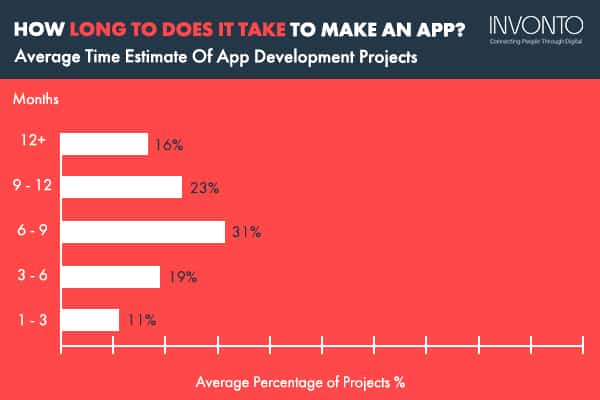
In our experience, the average app development timeline ranges between 4 to 6 months. Some applications can be developed in as little as one month, while highly complex enterprise platforms may take more than a year. The timeline depends on several factors, including the complexity of the application, technical requirements, integrations, user experience expectations, and the overall development approach.
Let’s take a closer look at the app development timeline and the factors that influence it.
The app development timeline
A successful app requires much more than development alone. Modern application development involves strategy, design thinking, execution, testing, launch, marketing, and ongoing support. You cannot simply build an app and expect adoption. A strong digital product strategy should define your goals, user needs, business requirements, and long-term roadmap before development begins.
You also need the right development team, scalable technology architecture, and a clear go-to-market strategy. Even after launch, the work continues through app maintenance, performance optimization, feature enhancements, analytics monitoring, and user feedback iteration.
We cover the complete mobile app development process in a separate article. Let’s briefly talk about it within the context of an app development timeline.
Strategy
Before you build anything, you need a plan. During this stage, you solidify the scope of your app’s functionality. You need to document how your app will solve a particular problem. Are other companies or apps solving the same problem? You will need to conduct competitor research to understand the market. Identify your short and long term mobile app project milestones. This will help you avoid common development mistakes. You will need to decide who will be developing your project. Will you be developing mobile apps in-house? Maybe hiring a mobile app development agency is better? We have a detailed guide on mobility strategy here. Expect to spend between 2 – 4 weeks creating your app development strategy.
App Development
At this point, you should have a well-defined product strategy and roadmap. The next step is beginning the actual app development process by identifying project requirements, milestones, deliverables, and technical architecture.
This phase includes designing the app’s user interface (UI) and user experience (UX). Most modern applications begin with wireframes and evolve into interactive prototypes that allow teams to validate workflows and user journeys before development starts. Following a Design Thinking approach during this phase helps ensure the product is intuitive, scalable, and aligned with actual user needs.
Once prototypes are approved, the development team begins building the application using modern app development frameworks, cloud platforms, APIs, and scalable backend services. Throughout development, the team conducts quality assurance testing, performance testing, and usability testing to ensure the application performs reliably across devices and platforms.
The application must also go through deployment preparation and app store approval processes where applicable. Depending on complexity, app development typically takes between 16 to 20 weeks to complete.
App Marketing
At this point, you should have a well-defined product strategy and roadmap. The next step is beginning the actual app development process by identifying project requirements, milestones, deliverables, and technical architecture.
This phase includes designing the app’s user interface (UI) and user experience (UX). Most modern applications begin with wireframes and evolve into interactive prototypes that allow teams to validate workflows and user journeys before development starts. Following a Design Thinking approach during this phase helps ensure the product is intuitive, scalable, and aligned with actual user needs.
Once prototypes are approved, the development team begins building the application using modern app development frameworks, cloud platforms, APIs, and scalable backend services. Throughout development, the team conducts quality assurance testing, performance testing, and usability testing to ensure the application performs reliably across devices and platforms.
The application must also go through deployment preparation and app store approval processes where applicable. Depending on complexity, app development typically takes between 16 to 20 weeks to complete.
App Support
It is difficult for an app to succeed without a clear marketing and user acquisition strategy. Without visibility, even a great application may struggle to gain traction.
Developing an app marketing strategy takes time and should ideally begin before launch. You should evaluate different marketing channels including social media, content marketing, email campaigns, influencer partnerships, paid advertising, SEO, ASO (App Store Optimization), and public relations.
However, not every channel is necessary for every app. Focus on the channels where your target audience is most active. A well-planned marketing strategy can significantly improve downloads, engagement, retention, and long-term growth.
Developing a marketing strategy may take between 1 to 4 weeks, while execution and optimization remain ongoing efforts after launch.
Understanding Project Scope
Project scope defines the overall purpose, technical requirements, user stories, integrations, timelines, and business objectives of your application. Properly defining scope is one of the most important factors in estimating development time and cost accurately.
A clearly defined scope helps development teams understand the complexity of the project while minimizing delays and unexpected changes later in the process.
Low Complexity Mobile Apps
Low complexity mobile apps typically contain a limited number of screens with a simple user interface and minimal functionality. These applications often do not require backend systems, cloud infrastructure, or API integrations.
Examples include calculators, timers, basic productivity apps, or simple to-do list applications. Because they serve a focused purpose with limited functionality, an experienced development team can often complete these projects within 8 to 10 weeks.
Moderate Complexity Mobile Apps
Moderately complex mobile applications are usually data-driven and require backend systems, databases, APIs, authentication, and cloud integration.
These apps often include custom UI/UX design, user accounts, administrative dashboards, analytics, and integrations with third-party services. Examples include mobile banking apps, field service applications, logistics platforms, project management tools, healthcare portals, and product catalog systems.
Moderate complexity apps typically require between 4 to 6 months of development time.
High Complexity Mobile Apps
Most enterprise-grade and consumer-scale applications fall into this category. These apps often include sophisticated UI/UX design, cloud-native architecture, real-time functionality, payment processing, AI capabilities, third-party integrations, advanced security, and large-scale infrastructure requirements.
High complexity apps may also require multilingual support, advanced analytics, machine learning features, custom animations, streaming capabilities, or IoT integration.
Examples include platforms like Netflix, Uber, TikTok, Instagram, Amazon, Airbnb, Spotify, and Duolingo. Delivering applications at this level often requires more than 12 months of development time along with ongoing iteration after launch.
What can slow down app development?
The complexity of features plays a major role in development timelines, but many additional factors can delay app development projects.
Scope Changes
Changes are a natural part of the product development process. Even the best teams cannot anticipate every requirement upfront. As development progresses, new ideas, technical considerations, and business priorities often emerge.
However, introducing too many changes during development can lead to scope creep, which impacts timelines, budgets, and team productivity. It is important to balance innovation with project stability by prioritizing features based on business value and user needs.
Maintaining transparent communication between stakeholders, designers, developers, and project managers helps minimize unnecessary delays and keeps the project aligned with original goals.
Hiring Inexperienced App Developers
All developers are not equal. Who you hire matters just as much as what you build. Freelancers, in-house developers and app development agencies build apps. It depends on your needs, but you should consider a few things. Firstly, understand that building an app requires a team. This team consists of different skill sets. Teams can have a manager, designer, app developers, back-end developers, and testers. If you hire freelancers, you’ll need several to fill each role. Managing their work can become challenging and time-consuming. Hiring in-house means you are adding fixed costs to your payroll. So you will have to commit to your mobile app projects for at least a few years. If you need specialists, an app development agency is an option. The developers you hire should have enough experience for your project. Ask them to showcase a portfolio of their app development projects. Inexperienced developers could mean a lot of trial and error. Hiring them will be more expensive. Not only will you lose time, but you may receive a poor quality product. You don’t want to launch an app that does not function.
Innovating with Emerging Technologies
Companies are implementing emerging technologies into their apps. These include virtual reality, augmented reality, and machine learning. They offer immense value to companies willing to make the investment.
To develop a virtual reality or augmented reality app, you need to consider a few things. Both VR and AR require additional hardware and software. Invonto uses Oculus Quest and Unity to develop virtual reality apps. We recently assisted Merck in building a virtual reality simulation of their laboratory. The project required Unity developers, 3D modelers, and knowledge of Oculus hardware. Augmented reality requires specific SDKs to develop apps for each platform. If you want to develop an AR app for iOS devices you need ARKit. If you want to develop an AR app for Android devices you need ARCore.
You can build machine learning powered applications using platforms like Amazon ReKognition services, Microsoft Azure Cognitive services, and Google AI services. To implement machine learning, you need data. You need ALOT of data. ML is powering businesses through image recognition, predictive maintenance, and process automation.
The success of emerging technologies is mostly unproven. Today, we are seeing these technologies implemented in different industries. Large enterprises are investing heavily in these technologies because there is high potential. Naturally, this introduces risk. We suggest developing a proof-of-concept to ensure your investment is well-placed.
Learn More: How virtual reality will impact businesses in 2020
How can you speed up the app development process?
Delays are common in software projects, but there are proactive steps you can take to improve efficiency and reduce unnecessary setbacks.
Developing a Product Roadmap
A product roadmap defines the vision, priorities, milestones, and long-term direction of your application. It helps development teams stay aligned while giving stakeholders visibility into progress, timelines, and priorities.
A strong roadmap also makes it easier to adapt when business requirements or market conditions change.
Building Your MVP
Developing your mobile app can be an exciting venture. Most business leaders want to be the next hit success. They want to be the next Uber or the next Instagram. These high aspirations are great, but don’t make the mistake of feature bloat. Feature bloat is the result of packing too many features in a product. The first version of your app should be distilled to its essential components. Remove the “bells and whistles” and focus on core functions. This reduces how long it takes to create an app, and reduces the cost. Build an MVP first and test it with your market. User feedback will help you determine future direction. If feedback is negative, you need to take a step back and reevaluate.
Hiring Experienced App Developers
Choosing experienced app developers can significantly improve project outcomes. Look for agencies or development teams with strong portfolios, proven technical capabilities, and experience across multiple industries.
Review their case studies, evaluate the quality of their UI/UX design work, and assess whether they follow modern development standards and technologies. Teams that only showcase outdated projects or legacy design patterns may struggle to deliver modern digital experiences.
It is also important to think beyond launch. Choose development partners who can provide long-term support, maintenance, scalability planning, and continuous product improvement.
How do you estimate how long will it take to make an app?
Estimating app development timelines requires a strong understanding of software development processes, technical architecture, integrations, and project complexity.
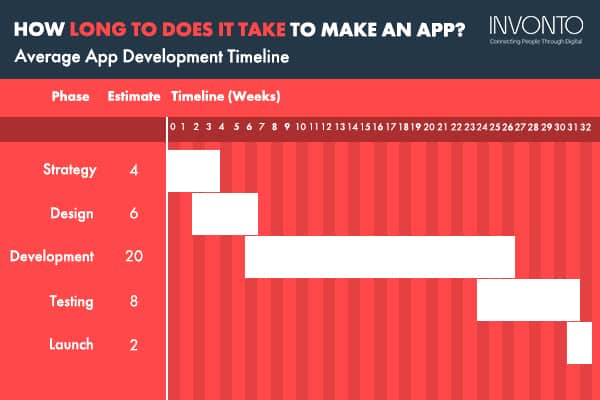
One commonly used framework is the 10/15/50/20/5 rule. In many projects, roughly 15% of time is spent gathering requirements and defining strategy, 20% on UI/UX design, 40% on development, 20% on testing and quality assurance, and 5% on deployment and DevOps preparation.
For example, if strategy and requirements take 4 weeks, design may require 6 weeks, development could require 20 weeks, testing may take 8 weeks, and deployment preparation another 2 weeks.
However, software development is rarely perfectly linear. Feedback cycles, testing iterations, stakeholder reviews, integrations, and unexpected technical challenges often extend timelines. Because of this, many teams add an additional 20% to 25% buffer to their original estimate.
Every app development project is different. There is no universal formula for estimating timelines accurately, which is why working with experienced product strategists and development experts is critical.
Conclusion
Some apps are overnight success stories. Most apps require months, even years to find that success. App development requires skills and a methodical approach. To figure out how long does it take to make an app, you need to understand the full project scope and know how to create an app. The team you hire and the complexity of your app impact costs and timeline.
Interested in learning more about our mobile app development capabilities or want our app developers to analyze your idea and provide an estimate? Contact us today to schedule a free consultation with our team.